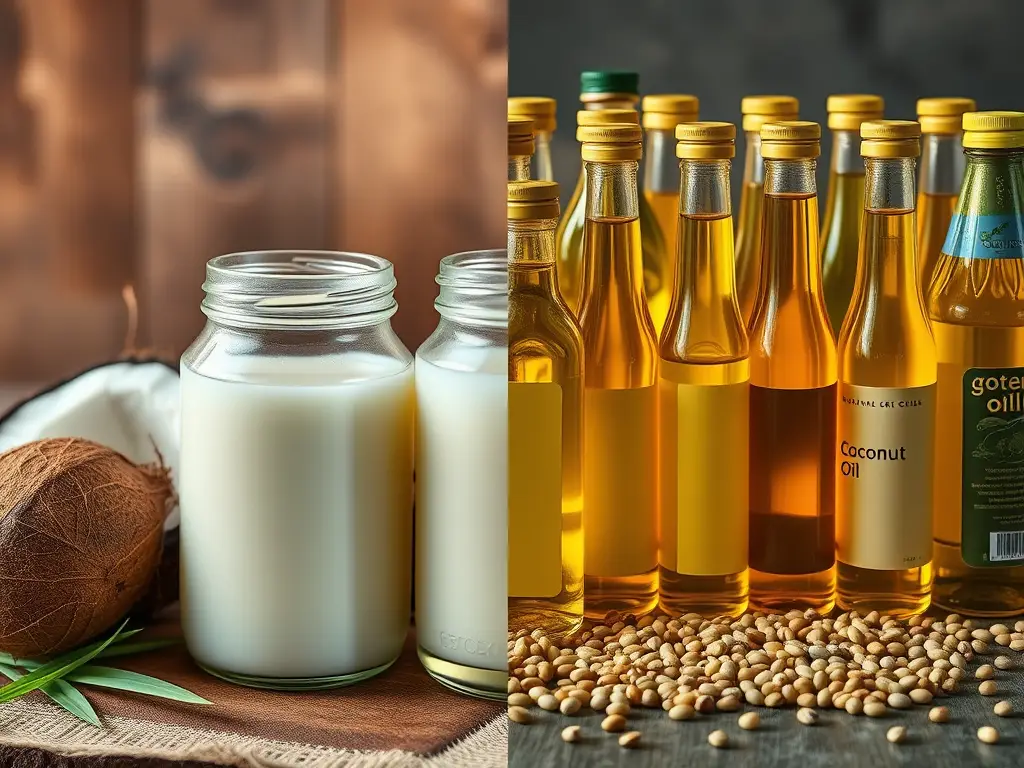
For years people have been told to replace saturated fats with vegetable oils. The assumption was simple. Vegetable oils lower LDL cholesterol, therefore they must be better for heart health.
Modern evidence does not support that simple narrative.
When you look at oxidation, inflammation, lipid particle quality, and real world dietary patterns, vegetable oils typically create more harm than coconut oil. Both fats have trade offs, but their biological effects are very different.
This article explains the science clearly so you know which option aligns best with long term metabolic health.
Fatty Acid Composition: Why This Matters More Than People Think
Coconut Oil
Coconut oil is roughly 90 percent saturated fat. Most of that is lauric acid, a medium chain fatty acid. Saturated fats are naturally stable which means they resist heat, oxidation, and breakdown during cooking. Coconut oil raises LDL cholesterol modestly, but it also raises HDL significantly and often shifts LDL particles toward a larger, less atherogenic pattern.
Vegetable Oils
Vegetable oils like soybean, corn, safflower, sunflower, canola, and cottonseed oil are high in polyunsaturated fats. Most of these polyunsaturated fats are omega 6 linoleic acid which is chemically unstable. When heated they break down into lipid peroxides and aldehydes. These compounds damage cells, injure arterial tissue, and increase inflammation.
The type of fat determines how it behaves under heat and inside the body. This is why the composition difference between coconut oil and vegetable oils produces very different health outcomes.
Oxidation and Cooking Stability
Oxidation is one of the most important factors that separates these two oils.
Vegetable Oils
Because they contain high amounts of polyunsaturated fats, vegetable oils oxidize easily. When heated in a pan, a fryer, or even in a factory, they generate toxic products like aldehydes and lipid peroxides. Studies have repeatedly shown that these compounds can damage DNA, disrupt membranes, and contribute to cardiovascular disease.
Coconut Oil
Coconut oil is highly resistant to oxidation due to its saturated fat content. It produces far fewer toxic byproducts during cooking. For people who cook frequently, this stability is a significant advantage.
Effects on Blood Lipids and Lipoproteins
Most public messaging focuses only on LDL cholesterol levels, but this is incomplete. The type of LDL particles, the oxidation state of those particles, and the presence of inflammation matter far more.
Coconut Oil
Research shows that coconut oil raises both LDL and HDL. The HDL increase is substantial and improves the LDL to HDL ratio. Coconut oil also favors a shift toward larger LDL particles which are less likely to penetrate the arterial wall.
Vegetable Oils
Vegetable oils can lower LDL cholesterol on paper. However, that does not guarantee better outcomes. High omega 6 intake can increase small dense LDL and oxidized LDL. Oxidized LDL is far more harmful than elevated LDL that is stable and unoxidized.
Large clinical reanalyses have shown that replacing saturated fat with linoleic acid lowered LDL but did not reduce heart attacks. In some cases, it increased cardiovascular mortality. This challenges the idea that vegetable oils are automatically protective.
Omega 6 Overload and Inflammation
The modern diet contains far more omega 6 linoleic acid than any time in human history. Excess omega 6 intake is linked to:
- Elevated inflammatory markers
- Increased conversion into arachidonic acid
- Greater production of inflammatory eicosanoids
- Higher risk of metabolic dysfunction
Vegetable oils are the primary source of this imbalance. Coconut oil does not contribute to omega 6 overload which makes it less inflammatory by default.
Real World Dietary Behavior
In real life, people consume massive quantities of vegetable oils because they are the backbone of ultra processed foods.
Vegetable oils are found in:
- Fast food
- Restaurant fryers
- Packaged snacks
- Baked goods
- Chips
- Crackers
- Dressings
- Sauces
- Margarines
- Frozen meals
This means most people consume oxidized polyunsaturated fats every day without noticing.
Coconut oil is rarely used in processed foods and is typically consumed intentionally in home cooking. This difference alone creates a huge gap in overall health impact.
Which Is Better for You?
Coconut Oil: Generally Better
- More stable during cooking
- Less oxidation
- Supports a higher HDL level
- Promotes larger LDL particle size
- Less inflammatory
- Does not contribute to omega 6 overload
Vegetable Oils: Generally Worse
- Highly prone to oxidation
- Produce harmful aldehydes when heated
- Can increase small dense LDL and oxidized LDL
- Drive chronic inflammation
- Overconsumed in processed foods
- Correlate with poorer metabolic outcomes in population studies
If your goal is to improve metabolic health, reduce inflammation, and support favorable lipid particle patterns, coconut oil is usually the better option.
Final Takeaway
Coconut oil is not a miracle food, but when compared to the high omega 6 vegetable oils used in modern processed diets, it is the safer and more metabolic friendly choice. Its stability, lower oxidation risk, and positive impact on HDL make it a better option for daily cooking. Vegetable oils are far more likely to promote inflammation, oxidative damage, and lipid dysfunction when consumed at modern levels.
If you want the healthiest approach, pair coconut oil with olive oil, avocado oil, and whole food fats rather than relying on industrial seed oils.
References
- Grootveld M et al. “Consumption of cooking oils and formation of toxic aldehydes.” Food Chemistry. 2015.
- Guillén M, Goicoechea E. “Oxidation of polyunsaturated oils at high temperatures.” Journal of Agricultural and Food Chemistry. 2008.
- Neelakantan N et al. “Coconut oil and cardiovascular risk.” Nutrition Reviews. 2020.
- Cox C et al. “Coconut oil consumption and lipid markers.” BMJ Open. 2018.
- Ramsden C et al. “Reanalysis of the Minnesota Coronary Experiment.” BMJ. 2013.
- Ward M et al. “Effects of linoleic acid on oxidized LDL levels.” Atherosclerosis. 2017.
- Simopoulos A. “Omega 6 to omega 3 ratio and inflammation.” Biomed Pharmacother. 2002.
- Fritsche K. “Linoleic acid and inflammatory pathways.” Nutritional Health. 2008.
Leave a Reply