The Macro Blueprint: How High-Performers Calculate Macronutrients Without Obsessing
You’ve nailed your calorie deficit. You know exactly how much to eat to lose fat. But calories are only half the equation. The other half is macronutrients—protein, carbohydrates, and fat. Get your macros wrong, and you’ll lose muscle instead of fat. You’ll feel sluggish instead of sharp. You’ll sacrifice performance instead of optimizing it.
This isn’t about becoming a macro-counting robot. This is about understanding the framework so you can make informed decisions. You’re an engineer. You understand systems. Macronutrients are the system that determines whether your calorie deficit builds the body you want or just makes you smaller and weaker.
Why Macros Matter More Than Calories Alone
A calorie is not just a calorie when it comes to body composition. One hundred calories of chicken breast and one hundred calories of candy have the same energy value, but they have radically different effects on your muscle mass, satiety, and metabolic rate. Protein builds and preserves muscle. Carbohydrates fuel performance and recovery. Fat supports hormone production and nutrient absorption. The ratio matters.
Research shows that during a calorie deficit, inadequate protein intake results in loss of fat-free mass—muscle. A study published in the Journal of Obesity and Metabolic Syndrome found that sufficient protein intake of 1.6 to 2.2 grams per kilogram of body weight per day is essential during weight loss to preserve lean mass. If you’re eating in a deficit but not hitting your protein target, you’re losing muscle along with fat. That’s not fat loss. That’s just weight loss. And weight loss without muscle preservation leaves you weaker, slower, and with a lower metabolic rate.
The High-Performer’s Macro Framework
Here’s the framework that works for busy professionals who want to lose fat, preserve muscle, and maintain performance. Start with protein. Set it high. Then allocate the rest of your calories between carbohydrates and fat based on your activity level and personal preference.
Protein: 0.8 to 1.0 Grams Per Pound of Body Weight. This is your non-negotiable. For a 180-pound individual, that’s 144 to 180 grams of protein per day. Research from Examine.com recommends 1.6 to 2.4 grams per kilogram of body weight for athletes and lean individuals to maximize fat loss and minimize muscle loss. If you’re resistance training and in a calorie deficit, aim for the higher end. Protein is the most satiating macronutrient, supports muscle protein synthesis, and has the highest thermic effect of food—meaning your body burns more calories digesting protein than carbs or fat.
Carbohydrates: 30 to 40 Percent of Total Calories. Carbs are not the enemy. They fuel your training, support recovery, and keep your brain sharp during long work days. For a 2,000 calorie diet, that’s 150 to 200 grams of carbs per day. If you’re highly active—training five or more days per week—aim for the higher end. If you’re sedentary or prefer a lower-carb approach, aim for the lower end. The key is to match your carb intake to your activity level. Don’t cut carbs just because you think it’s “cleaner.” Cut carbs only if it helps you adhere to your deficit.
Fat: 25 to 35 Percent of Total Calories. Fat is essential for hormone production, including testosterone. A study in the Journal of Sports Science and Medicine found that drastically reduced fat intake can result in a reduction in circulating testosterone levels. For a 2,000 calorie diet, that’s 55 to 78 grams of fat per day. Don’t go below 0.3 grams per pound of body weight. For a 180-pound individual, that’s a minimum of 54 grams of fat per day. Prioritize unsaturated fats from sources like olive oil, avocados, nuts, and fatty fish.
The Practical Application: A Sample Calculation
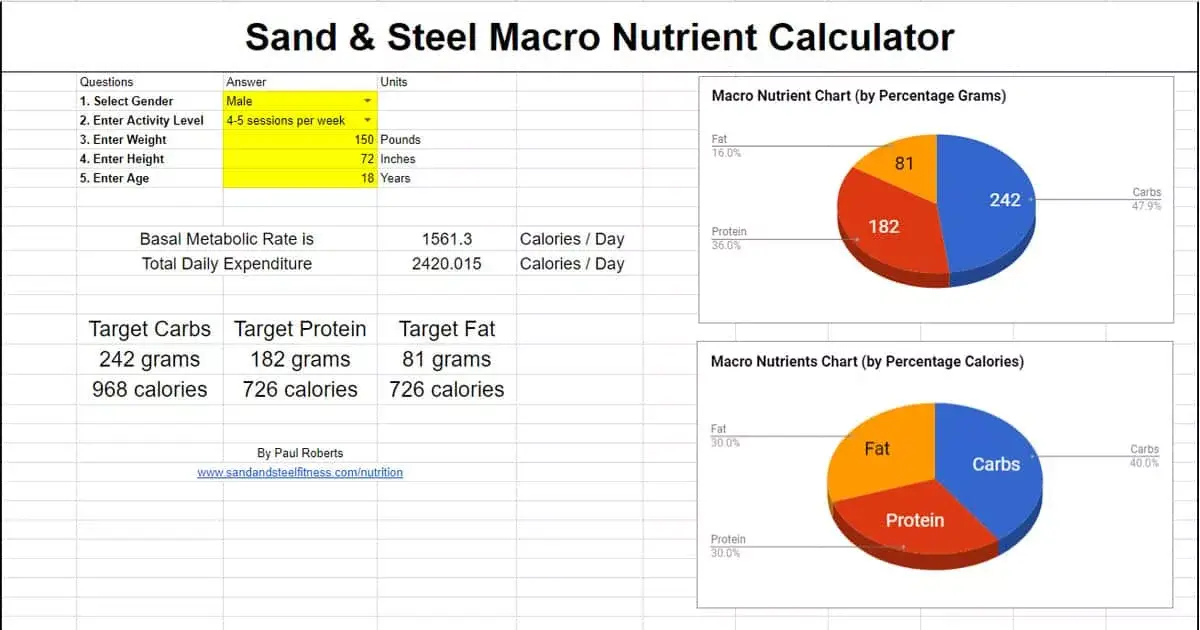
Let’s walk through a real example. You’re a 180-pound male. Your TDEE is 2,500 calories. You’re targeting a 500 calorie deficit, so your daily calorie target is 2,000 calories. Here’s how you calculate your macros.
Protein: 180 pounds times 1.0 grams per pound equals 180 grams of protein. At 4 calories per gram, that’s 720 calories from protein.
Fat: 180 pounds times 0.4 grams per pound equals 72 grams of fat. At 9 calories per gram, that’s 648 calories from fat.
Carbohydrates: 2,000 total calories minus 720 protein calories minus 648 fat calories equals 632 calories remaining. At 4 calories per gram, that’s 158 grams of carbs.
Your macro targets: 180 grams protein, 158 grams carbs, 72 grams fat. Total: 2,000 calories. This is your blueprint. You don’t need to hit these numbers to the gram every day. But you should be within 10 percent most days. That’s the balance between precision and flexibility.
Adjusting Macros Based on Progress
Macros are not static. As you lose weight, your TDEE decreases. As your training volume changes, your carb needs change. As you get leaner, your protein needs may increase slightly to preserve muscle. The key is to track your progress and adjust every four to six weeks.
If you’re losing weight too fast—more than two pounds per week—increase your calories slightly, prioritizing carbs or fat. If you’re not losing weight after two weeks, decrease your calories by 100 to 200, cutting from carbs or fat, not protein. If your strength is dropping, increase your carbs or reduce your deficit. If you’re constantly hungry, increase your protein or add more volume from low-calorie vegetables. This is iterative. This is data-driven. This is how you engineer your physique.
The Bottom Line: Structure Without Obsession
Calculating macros is not about perfection. It’s about having a framework that guides your decisions. You don’t need to weigh every meal to the gram. You don’t need to stress if you’re off by 10 grams of carbs. But you do need to know your targets. You do need to track your intake for at least a few weeks to calibrate your portion sizes. And you do need to prioritize protein above all else. That’s the system. That’s the discipline. That’s how you lose fat without losing muscle.
Key Takeaways
- ✓Macronutrient ratios determine whether you lose fat while preserving muscle or just lose weight indiscriminately.
- ✓Protein is the most critical macronutrient during a calorie deficit: aim for 0.8 to 1.0 grams per pound of body weight.
- ✓Carbohydrates should be matched to your activity level: 30 to 40 percent of total calories for most active individuals.
- ✓Fat intake should not drop below 0.3 grams per pound of body weight to support hormone production.
- ✓Calculate macros by setting protein first, then allocating remaining calories between carbs and fat based on preference and activity.
- ✓Adjust macros every four to six weeks based on weight loss rate, strength performance, and hunger levels.
Take Action
Follow me on IG @SeanFitEngineer for actionable strategies. Want help building your personalized execution plan? Book a free strategy call to see if we’re a fit.
References
[1] Kim, J. Y. (2020). Optimal Diet Strategies for Weight Loss and Weight Loss Maintenance. Journal of Obesity & Metabolic Syndrome, 30(1), 20-31. https://pmc.ncbi.nlm.nih.gov/articles/PMC8017325/
[2] Examine.com. (2024). Optimal Protein Intake Guide & Calculator. https://examine.com/guides/protein-intake/
[3] Helms, E. R., Aragon, A. A., & Fitschen, P. J. (2014). Evidence-based recommendations for natural bodybuilding contest preparation: nutrition and supplementation. Journal of the International Society of Sports Nutrition, 11, 20.
Leave a Reply