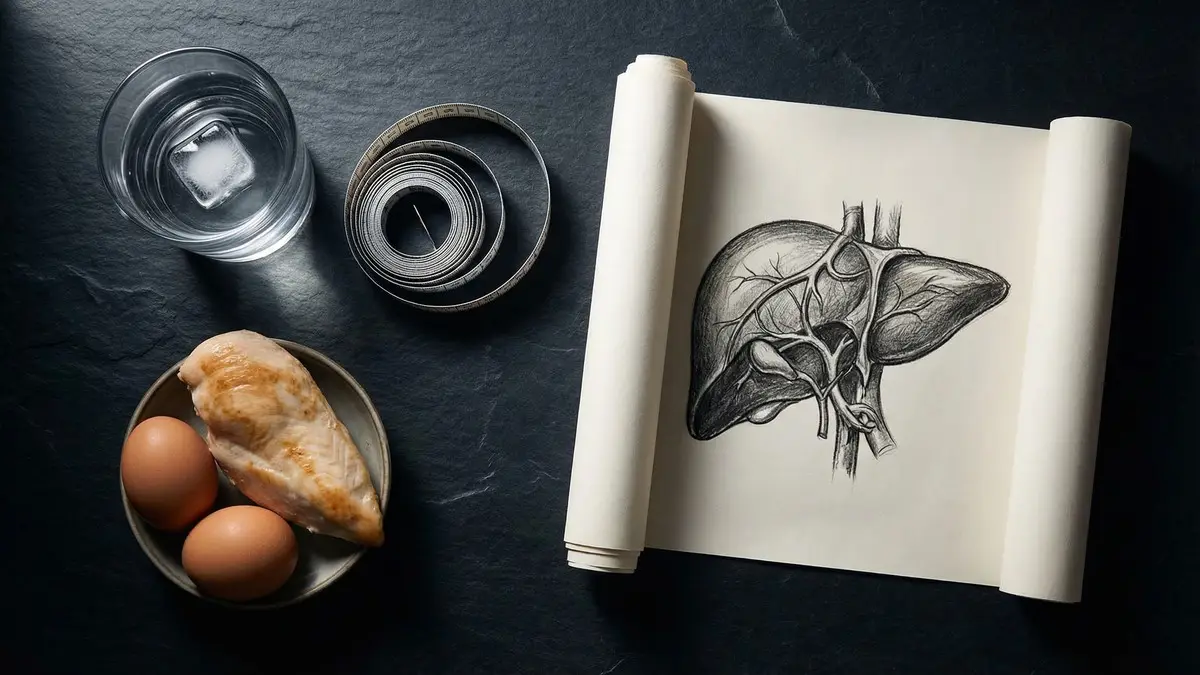
You are a high-performing engineer or tech professional. You track your macros. You train. You sleep seven hours. But the fat around your midsection will not move. Before you slash another 200 calories or add a fourth cardio session, consider this: the problem may not be your discipline. It may be your liver, silently degrading the efficiency of your entire fat loss system.
Most people never think about their liver when they think about fat loss. That is a mistake. Your liver is not just a detox organ. It is the central processing unit of your metabolism. When it is compromised, your entire fat loss system slows down — regardless of how disciplined you are.
What Your Liver Actually Does for Fat Loss
Think of your liver as the logistics hub of your body. Every nutrient you eat passes through it. It decides what gets burned for energy, what gets stored as glycogen, and what gets converted to body fat. It also produces bile, which is required to digest and absorb dietary fat. It regulates blood sugar. It processes hormones. It handles over 500 documented metabolic functions.
When your liver is healthy, this system runs efficiently. Nutrients are processed quickly. Fat is mobilized when you are in a deficit. Insulin sensitivity stays high. But when your liver starts accumulating fat — a condition called Non-Alcoholic Fatty Liver Disease (NAFLD) — the entire system degrades. And NAFLD is far more common than most people realize. Estimates suggest it affects 25 to 30 percent of adults in Western countries.
How a Fatty Liver Blocks Fat Loss
Here is the mechanism. When your liver accumulates excess fat, it becomes inflamed. That inflammation triggers insulin resistance — a state where your cells stop responding normally to insulin. When insulin resistance sets in, your body cannot efficiently use glucose for energy. Instead, it defaults to storing more as fat. Your fat cells become harder to access. Your deficit becomes less effective. You feel like you are doing everything right and getting nowhere.
The cycle looks like this:
- Poor diet drives excess sugar and refined carbs into the liver
- Liver converts the excess into fat and stores it internally
- Fat accumulation causes inflammation and insulin resistance
- Insulin resistance makes fat mobilization harder
- You stay stuck despite being in a calorie deficit
This is not a willpower problem. It is a systems problem. And systems problems require systems solutions.
What Causes a Fatty Liver in High Performers
You do not need to be overweight or drink alcohol to develop NAFLD. The primary drivers in busy tech professionals are:
- Excess fructose and refined sugar — energy drinks, sweetened coffee, processed snacks, and alcohol all dump sugar directly into the liver
- Chronic sleep deprivation — poor sleep elevates cortisol, which drives visceral fat accumulation around and inside the liver
- Sedentary behavior — sitting 10 to 12 hours a day with minimal movement reduces the liver’s ability to clear fat
- Crash dieting — rapid weight loss paradoxically floods the liver with free fatty acids, worsening the condition short-term
- High alcohol intake — even moderate regular drinking accelerates liver fat accumulation
Sound familiar? These are the exact lifestyle patterns of the average high-performing tech professional who has been struggling with stubborn fat for years.
How to Fix It: The Engineered Approach
The good news is that NAFLD is reversible. The liver has a remarkable capacity to regenerate when you remove the inputs causing the damage and replace them with inputs that support recovery. Here is what the data supports:
- Calorie deficit with high protein — a moderate deficit of 300 to 500 calories below TDEE, anchored by 1g of protein per pound of bodyweight, reduces liver fat while preserving muscle. Crash dieting makes this worse, not better.
- Eliminate liquid sugar — cut sweetened drinks, energy drinks, fruit juice, and alcohol. These are the fastest inputs driving liver fat accumulation.
- Strength training — resistance training directly reduces liver fat independent of weight loss. Three to four sessions per week is the minimum effective dose.
- Daily movement — 8,000 to 10,000 steps per day improves insulin sensitivity and helps the liver clear fat. This is not optional.
- Sleep 7 to 9 hours — sleep is when liver repair and metabolic reset happens. Cutting sleep to work more is cutting your fat loss results.
- Hydration — minimum 3 liters of water per day supports liver filtration and bile production.
Notice that every single one of these interventions maps directly to the Five Pillars of structured fat loss. This is not a coincidence. The Five Pillars are not just about aesthetics. They are about restoring the metabolic machinery that makes fat loss possible in the first place.
What to Avoid
Two popular approaches actively make a fatty liver worse and should be removed from your toolbox immediately:
- Intermittent fasting as a primary strategy — prolonged fasting spikes cortisol and floods the liver with free fatty acids during the re-feed window. For someone with early-stage NAFLD, this can worsen inflammation. Consistent structured eating with adequate protein is a better system.
- Aggressive calorie restriction below 1,200 calories — rapid fat mobilization overwhelms the liver’s processing capacity. Slow, structured deficits win every time.
The Bottom Line
If you have been disciplined for months and the scale is not moving, your liver deserves a serious look. Get bloodwork done. Check your ALT and AST liver enzyme levels. Ask your doctor about a liver ultrasound if warranted. Do not assume your system is working correctly just because you are following a plan.
Fat loss is engineered, not guessed. And a broken component in the system produces broken results — no matter how hard you push.
Key Takeaways
- ✓Your liver controls fat metabolism. A compromised liver means compromised fat loss — regardless of your deficit.
- ✓NAFLD affects 25-30% of Western adults and is driven by excess sugar, poor sleep, sedentary behavior, and alcohol — not just obesity.
- ✓Liver fat causes insulin resistance, which makes your calorie deficit less effective and fat mobilization harder.
- ✓NAFLD is reversible with a structured deficit, high protein, strength training, daily steps, adequate sleep, and hydration.
- ✓Intermittent fasting and aggressive calorie restriction make a fatty liver worse. Structured, consistent eating wins.
- ✓Get bloodwork done. Check ALT, AST, and ask about a liver ultrasound if you have been stuck for months despite doing everything right.
Take Action
If you have been stuck despite doing everything right, the problem is systemic — not motivational. Comment LIVER below if this post opened your eyes. Follow me on IG @SeanFitEngineer for daily engineered fat loss strategies. Ready to fix your system? Book a free strategy call.
References
[1] Younossi ZM, et al. “Global epidemiology of nonalcoholic fatty liver disease.” Hepatology, 2016.
[2] Chalasani N, et al. “The diagnosis and management of nonalcoholic fatty liver disease.” Hepatology, 2018.
[3] Keating SE, et al. “Effect of aerobic exercise training dose on liver fat and visceral adiposity.” Journal of Hepatology, 2015.
[4] Rector RS, et al. “Liver fat and insulin resistance.” American Journal of Physiology, 2008.
Leave a Reply